Partially Charged
During my recent vacation in San Diego, I spent a considerable amount of time driving an electric vehicle. While it wasn’t my first time experiencing an EV, it was undoubtedly my longest. My nearly week-long rental of a 2023 Hyundai Ioniq 5 was covered in my San Diego vacation write-up, but within a few hours of it being published, I realized I had more thoughts to share. Before I lost my train of thought or forgot what I wanted to say, I decided to jot them down. You will also be able to read some of my speculation about the future of EV's in the US market--spolier alert: it will be a dim future leading to another Malaise Era.
Longer review of the Ioniq 5
Both L. & I needed a few days for the EV to feel "normal" when we were behind its wheel. There's always an adjustment period when you rent a car, as you get used to its overall engine power, seat placement, instrument panel, and so on. Both of our cars hail from the 2015 model year, with L.'s car being a Toyota Prius and mine being a Kia Forte. I still have analog gauges in my car, whereas L.'s car has none (though all of her instruments and displays are centered around the middle of the dashboard). The Ioniq 5's dashboard shows off how much has changed with car interiors over the last 10 years, as it had two large screens that covered the upper two-thirds of the dashboard. One half of this large screen was oriented towards displaying important driver information like speed and range, while the other half was for entertainment and navigation purposes. The HVAC system resided underneath the second screen, with one strip of buttons and a lower strip of touch-sensitive temperature controls. Here's a photo from US News & World Report showing off the interior of a 2023 Ioniq 5, as it will be a better reference point than my description:
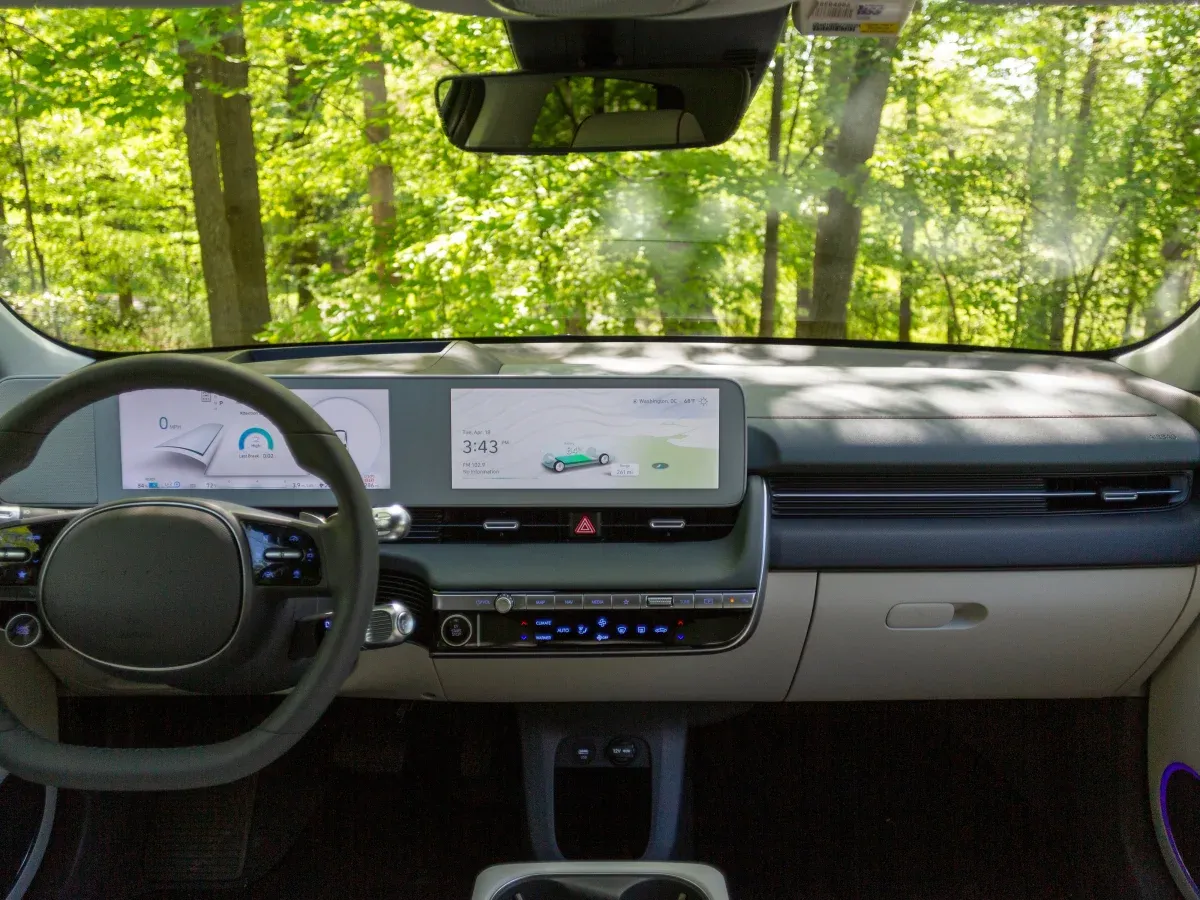
All of the screens and touch-sensitive controls were a distraction from driving. We often adjusted the car’s temperature due to the noticeable daily temperature changes in San Diego, but there was no tactile feedback when doing so. The strip of air vents in the middle of the dashboard proved inadequate for directing air to our bodies, as their narrow height limited the vertical range of heating or cooling. Worse yet, the panel of airflow and temperature control was just one long touch strip with no real separation between buttons. You had to deliberately look at the panel to adjust the air, so there was no way for a driver to do that without taking their eyes off the road. I would have distracted myself less if I spent my time texting while driving this car.
The second silver stalk sticking out from the right side of the steering wheel is the transmission selector. Unlike the other two stalks, this one doesn't move. You touch a button on the end of the stalk to shift into Park. To shift into Drive or Reverse, you twist the end of the stalk, with Neutral residing in between. Admittedly, an EV only has one forward gear and one reverse gear, so there was no real need to have a traditional gear shifter, but I thought this result was far too cute by half. It wasn't obvious how to use the stalk at first, nor was it obvious how to apply the Park gear. Honestly, this would have been a case where the late 50s/early 60s push-button transmission selection would have been a better option.
If you look at the exterior of the Ioniq 5, particularly the 2023 model I rented, you'll notice flush-mounted electronic door handles that are seemingly de rigueur for EVs. Similar to the transmission stalk, this is another design feature that's far too cute by half. Is it neat to have the door handles pop open when you walk up to the car, as the handles are triggered by proximity to your key fob? Yeah, it's a nice trick...at first. It's not really annoying so much as it's unnecessary. The flap covering the charge port (as seen in the earlier link) is also electronically controlled, and during my rental time I could never figure out how to open it from the driver's seat. I had to use the key fob to open the port, which again, is contrived and overly cute. There's likely a button on the interior I overlooked to open the port, but still. You'll also notice one seemingly regular exterior item missing from the rear of the Ioniq: no rear wiper! For reasons I don't fully understand, the 2021-2023 Ioniq 5 was sold without a rear window wiper, though this oversight was fixed with a 2024 model refresh. Practical design items were less on display with the Ioniq 5, with cutesy and showy details failing to make up the difference.


Now that I've gotten my complaints both large and small out of the way, let me talk about what I did like about the Ioniq. First and foremost, torque. The old car saying is that "Americans shop horsepower but buy torque," and an EV's primary driving advantage is that you get maximum torque at all times. The 2023 Ioniq 5 I rented was very likely had the Extra Long Range battery, as its maximum claimed range was 303 miles; during our first fast EV charging session, I was able to get the car maxed out at 302. The Extra Long Battery is, per Wikipedia, paired with a 168 kW rear-mounted motor that produces 225 hp and 258 lb-ft of torque. Merging on I-5 and I-15 in San Diego, as well as climbing the mountains around Anza-Borrego Desert State Park, were effortless affairs as the necessary power was available at a near-instant.
Also per Wikipedia, the Ioniq's weight was over two tons (in the 4200 - 4685 pound range), making our acceleration and climbing prowess all that more impressive. Stopping such a heavy vehicle is often fraught with danger, but the same motor providing all that torque can also provide stopping power with regenerative braking. In effect, you are reversing the polarity of the neutron flow flow of electricity to the motor, which in turn takes the energy from braking and applies it to the battery. The effect of regenerative braking is a lot like downshifting, either in an automatic or manual, which really pays off when driving downhill. Between the hills in San Diego, and when driving downhill from Palomar Mountain, the regenerative braking made the Ioniq so much easier to control. This car had four levels of regenerative braking power available to set, from 0 to 3, or you could choose the Automatic setting and let the car decide for you. I didn't trust the Auto setting, but throughout the rental period, I played with the manual settings and eventually decided on Level 1 for most driving experiences, 2 for somewhat hilly conditions, and 3 for descending mountains or mountain passes.
I won't talk too much about charging the Ioniq, as I already covered the topic in the San Diego vacation recap. I will say that the San Diego region, and likely Southern California as a whole, probably has the best EV infrastructure in the country. The trip to Anza-Borrego was a reminder to me that yes, I was driving an EV, and yes, I have to plan routes out better in the future were I to drive an EV there again. There is a slight loss of spontaneity with driving an EV, as you will have to determine where fast EV chargers can be made available, then schedule your route accordingly. It's not the worst detriment with EV ownership, but it can't be ignored, either.
Summation of EV's as a whole
My overall feeling with EV's remains the same as what I wrote in my vacation recap. I still remain slightly optimistic about the EV as an idea, though it would require a rethink on my part as an owner and driver to accommodate the infrastructure, be it where I live or where I plan to drive. San Diego likely was a best-case scenario for EV ownership, whereas St. Louis is...well, not the absolute worst, but it's probably in the lower half of the spectrum, what with the relative lack of charging networks and colder weather that saps battery life. It wouldn't be impossible to own an EV here, but your driving life and parking life would become radically different as a result.
As for the EV's themselves, I would appreciate more practical design touches within and without. Touch controls, electronic door handles, screens upon screens--these are detriments rather than features in my book. Many of these showy design elements came about because Tesla defined what an EV should have on offer, leading to many other car manufacturers both legacy and new feeling compelled to imitate. I was going to suggest that future EV's should mix in more practical design elements, but given how quickly the EV market has changed in the US, I have my doubts that I'll see these designs for sale.
A spiteful retrenchment of EV's has been spurred on by the second Trump administration, only adding more fuel to the fire of lower EV sales among traditional automakers and even EV-only brands like Tesla. During the years when many US and European automakers pivoted hard towards EV's, they shot themselves in the foot with many other short-sighted decisions, such as cutting back their entry-level gas vehicles, and reducing their model ranges to primarily SUV's and trucks. As of 2026, there are no more new vehicles in the US market with a starting price under $20,000, while entire brands have given themselves to a modern take on the Model T adage of "any car, as long as it's an SUV." All of these decisions, when paired with the hard turn towards EV investment, meant that automakers spent billions on investment with not much to show for their efforts. They'll now spend billions more to largely undo these investments, which won't be made up by increasing car sales. If you are still selling EV's, note that the $7500 credit offered for buying one is no longer valid, nor will companies like Tesla be able to make money selling emissions credits. As of 2026, it's not the best time to be selling EV's in the US...
Whither EV's?
...and to be blunt, I fear the future won't be getting any better. The EV market won't be entirely abandoned in the US, but it won't be the impetus for any future progress in automobile development. The lost decade or so of automotive development, which has seen the near-ubiquity of SUV's and trucks, as well as the depressing lack of color in car exteriors, will continue unabated as sellers in the US auto market will retreat to safe bets. If these companies were to engage in anything "bold," it will be regressive, like throwing Hemi V-8 engines in Jeeps or Ram trucks as a flex--never mind that its replacement engine is smaller, lighter, and has more power, it's simply "not a Hemi," and marketing that engine name will be all that matters. If you are still making EV's, the future ride will be a bumpy one according to my crystal ball:
- By 2030, Tesla will have largely retreated from selling its EV's to consumers. Its lineup will continue to shrink, with the Cybertruck "taking a break" from the market. Eventually, either the Model 3 or Model Y will remain, depending on which model sells more in its respective markets, and it will be the basis of the Cybercab "autonomous" vehicle that will comprise the total of Tesla's automotive sales. Older Tesla vehicles will still be supported with firmware and software updates, though I predict with older models, these updates won't come free anymore. I can even see the name of Tesla disappearing entirely in the next few years, as it gets folded into the SpaceX/xAI amalgamation. Whether or not the remaining Cybercabs get rebranded as xAI or Grok or X will become a ketamine-fueled decision.
- Also by 2030, I can also see the Rivian and Lucid brands disappearing as well from the US market. Both of these companies make really interesting EV's, but I have difficulty seeing them last as independent manufacturers for much longer. Rivian probably has the better chance of lasting, as its software deal with the VW Group means it could become a full-on partner down the road. Rivian technology could underpin the upcoming (and delayed) Scout, or it could be the basis for many VW Group vehicles going forward. Lucid, on the other hand, will simply be bought out for its technology.
- What's left of the EV market in the US will be split into segments: the current EV-only brands will remain as a shadow of their former selves; traditional automakers will offer fewer EV-only models (more on that below); and new players from China will either partner with the traditional automakers, or they'll sell their brands here outright. If they were to set up a partnership, it would be an ironic reversal of the setup imposed by the Chinese government when non-Chinese automakers entered its market. I'm not sure how successful the Chinese EV's would be in the US, in spite of lower prices, as there will be a bias stoked by the media and government against them. I still believe there will be an effort to get those cars to the US market, though.
- American and European automakers who made the EV pivot will decrease their pure-EV offerings, if not cancel them outright. There will be increased options for plug-in hybrids (PHEV) and extended-range electric vehicles (EREV)--which are also called series hybrids--but parallel hybrids will be the most conspicuous offerings for sale. This type of shift will further add to the feelings of the US auto market being in flux, though to be fair, these problems weren't caused by EV's alone as mentioned earlier.
- I personally hope that EV-only offerings will still be around, even in smaller numbers. One idea I'll give away for free will be to revive old car brands as the EV-only model, almost as if they were a subsidiary of the parent company. This could happen whether or not there's a US-China EV tie-up. An EV version of the Ford F-150 may rankle traditionalists, but if it were an EV truck under the Mercury name, it may come across differently. Chrysler could pivot its own name as an EV-only brand, or it could revive Plymouth or Eagle as its EV ambassador. Saturn could be the EV brand for GM, or they could return the Opel brand to the US market for that purpose. While this idea would run the risk of sidelining EV's, it has the potential to show off EV's as a clean sheet that's "separate" from the main brand. If these brands spark interest in EV's, even after all that's happened with the retrenchment, then some of the billions invested in it can bear fruit. If not, then the old brands go away and the parental brands motor on, so to speak.
Aside from my last entry, I'm not too optimistic about the EV future in the US market. We will see safe bets coming to the showrooms: more SUV's, more trucks, less exciting exterior colors, and worse gas mileage--all at increasing costs. Cars like the Ioniq 5 represented something of a new way to think about what a vehicle should be, and to be fair, not all of that thinking was successful. It was, however, something new. Because EV's are seen as both a sales and a cultural embarrassment, there won't be room for new thinking anymore. All the money spent towards bringing EV's to market will scar the US auto market for years to come, with our future Malaise Era being inevitable thanks to the retreat to "safety." Instead of gaudy personal luxury vehicles with poor gas mileage and build quality, we'll see six-figure luxury trucks and SUV's in its place. The future of the US car market will be a dull one, which means when it comes time to replace my Kia Forte, I'll likely be stuck in a sea of SUV's, all of which will be the color of home appliances. Pardon me while I throttle my excitement.